
Introduction
So you’ve created your Upwork account, spent a week polishing your profile, and now you’re sitting there wondering why nobody is sending you job invites. You refresh your notifications. Nothing. Sound familiar?
Getting that first client on Upwork as a Nepali freelancer isn’t impossible — but it does require a strategy most beginners never figure out until months later. This guide skips the generic advice and goes straight into what actually works in 2026, with the Nepali context in mind.
Why Upwork Works Well for Nepali Freelancers
Nepal’s freelancing market has grown dramatically over the past few years. Faster internet infrastructure across Kathmandu and even in cities like Pokhara, Butwal, and Biratnagar means geography is no longer the barrier it once was. And with the Nepali rupee exchange rate, even modest dollar-denominated projects can provide a meaningful income.
Upwork remains the most credible platform for mid-to-high-value freelance work globally. Unlike Fiverr — which tends to attract race-to-the-bottom pricing — Upwork allows you to build a real professional reputation, attract long-term clients, and gradually raise your rates.
The challenge? The platform is saturated. But you’re not competing with everyone on Upwork. You’re competing with whoever else applied to that specific job. That’s a completely different problem — and a solvable one
etition and the “no experience, no job” loop. Breaking it requires strategy, persistence, and smart optimization. Many Nepali freelancers report landing first client within 1-3 months with consistent effort.

Step 1: Set Up Your Profile the Right Way (Not the Usual Way)
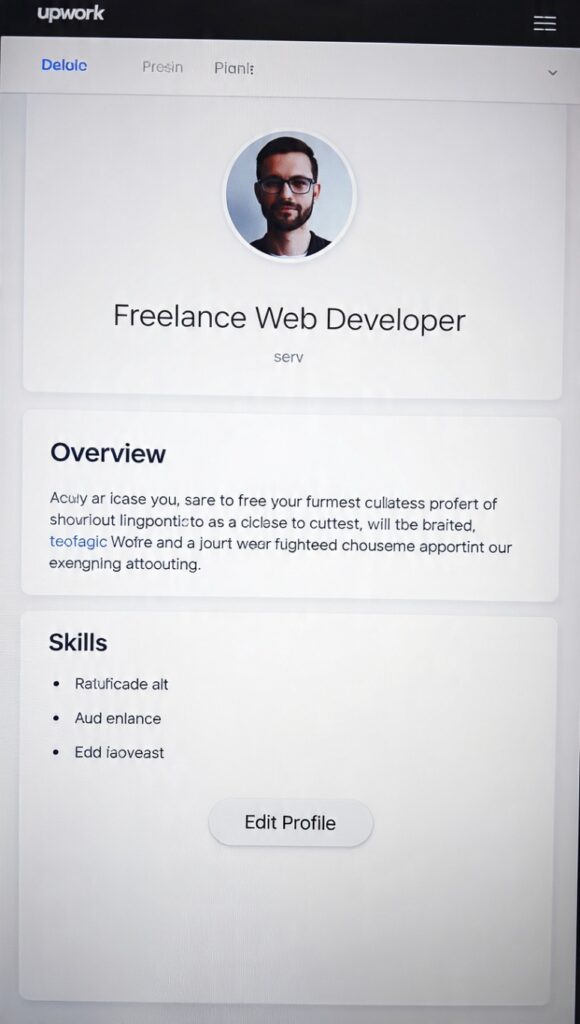
Most freelancers treat their Upwork profile like a resume. That’s mistake number one. Your profile is a sales page, and it needs to answer one question for potential clients: *Can this person solve my problem?*
Your Title Matters More Than you Think
Avoid vague titles like “Experienced Web Developer” or “Skilled Graphic Designer.” These say nothing. Instead, be specific about who you help and what outcome you deliver.
- Bad: Web Developer
- Better: WordPress Developer for Small Business Websites
- Best: WordPress Speed Optimization & Custom Theme Developer for E-commerce stores
Think about what a client actually types into the search bar. They’re not searching for “skilled freelancer.” They’re searching for “Shopify developer for product page redesign” or “video editor for YouTube channel.”
Write a Profile Overview That Speaks to the Client, Not About You
The first two lines of your overview show up in search results before a client even clicks your profile. Spend 80% of your effort on those two lines.
Here’s a structure that works:
- Line 1: Name the client’s problem or the outcome they want
- Line 2: Briefly establish credibility or your approach
- Rest: Expand on your process, what you deliver, and why working with you is different.
Expand on your process, what you deliver, and why working with you is different.
The Skills Section is a Keyword Magnet
Upwork’s search algorithm uses your listed skills to surface your profile in client searches. Research the exact terminology clients in your niche use. A client searching for “data visualization” might not find you if you only listed “data analysis.” Use both.
Fill all 15 available skill slots, but keep them genuinely relevant to what you actually do.
Profile Photo and Professionalism
This sounds obvious, but a clean, well-lit photo where you’re looking directly at the camera makes a genuine difference. You don’t need a professional photographer — good natural light near a window and a plain wall behind you works perfectly.
Step 2: Choose Your Niche Intelligently
Here’s the uncomfortable truth: generalists struggle on Upwork. Specialists win.
When a client has a React Native app that needs bug fixes, they’re not hiring “a developer.” They’re hiring someone who’s fixed React Native bugs before. The more specific your positioning, the easier it is to win work.
High-Demand Skills for Nepali Freelancers in 2026
These are areas where the combination of technical skill, English proficiency, and competitive (but not rock-bottom) pricing tends to work well:
Tech & Development:
- Web development (WordPress, Shopify, React, Laravel)
- Mobile app development (Flutter is particularly in demand)
- Python scripting and automation
- AI integration and prompt engineering
- QA testing and manual testing
Creative & Content:
- Video editing (YouTube, reels, short-form content)
- Graphic design (UI/UX, branding, social media assets)
- Content writing and blog posts (especially technical niches)
- Translation services (Nepali/Hindi to English and vice versa)
Digital Marketing & Business
- SEO (on-page, technical, and local SEO)
- Social media management
- Virtual assistant work
- Data entry and research
Emerging Opportunities
- AI-assisted content creation
- Chatbot development using tools like Voiceflow or Botpress
- No-code/low-code development (Bubble, Webflow, Zapier automation)
If you’re just starting, pick one area where you have even basic skill and go deep. You can always expand later once you have reviews.
Step 3: Connect Strategy- How to Actually Land That First Job
Upwork uses a bidding system with “Connects” (their internal currency). Each proposal costs between 2–16 Connects depending on the job tier. New accounts come with a small starting balance, and you’ll need to buy more.
Think of Connects as your marketing budget. Don’t waste them on jobs you’re unlikely to win.
How to Pick the Right Jobs to Apply
Apply to jobs posted in the last 24 hours
open, the more proposals it has. When you’re new with no reviews, you’re already at a disadvantage — don’t make it harder by being one of 50 proposals.
Look for these signals that the client is legitimate and ready to hire
- Payment method verified (check the job posting details)
- Hire rate above 60–70%
- Average hourly rate paid that aligns with what you’re asking
- A detailed, specific job description (not just “I need a developer”)
Avoid these early on:
- Jobs with 50+ proposals already
- Clients with zero previous hires on Upwork
- Vague job descriptions like “I need someone good”
- Suspiciously high offers from accounts with no history
The Proposal That Actually Gets Read
Upwork’s data consistently shows that shorter, more targeted proposals outperform long ones. Here’s why: clients reviewing 30+ applications do not read walls of text.
A proposal structure that works for beginners:
Hook (1-2 sentence): Show you read the job. Reference something specific from their description.
Relevance (2-3 sentence): Connect your skills directly to their stated problem.
Evidence (1-2 sentence): Mention something concrete — a project you did, a result you got, a tool you know well.
Next step (1 sentence): A soft call to action that feels helpful, not pushy.
Keep the total proposal to 100–150 words for most jobs. Save the detail for when they reply.
Here’s a rough example for a video editing job:
“Noticed you’re looking for someone who can turn long podcast recordings into punchy YouTube videos — that’s exactly the kind of editing I’ve been focusing on. I’m comfortable with Premiere Pro and DaVinci Resolve, and I understand the pacing that keeps viewers watching past the 2-minute mark. I’ve edited [X] similar projects recently and can share samples relevant to your content style. Would love to see a sample clip if you have one — happy to do a quick test edit to show you my approach.”
The Role of the Cover Letter Questions
Many Upwork job posts include screening questions. Answer them *directly and specifically*. Clients add these questions precisely because they want to filter out copy-paste proposals. A generic answer is a red flag. A specific, thoughtful answer — even a short one — signals professionalism.
Step 4: Handling the No-Review Problem
This is the biggest psychological barrier for new freelancers. You need reviews to get jobs, but you need jobs to get reviews. Here’s how to break out of it.Most beginners waste connects on generic proposals. Don’t do that.
Strategy 1: Price Competitively for Your First 2-3 Projects
You don’t need to work for free. But being realistic about your rate when you have zero reviews is smart. Once you have two or three five-star reviews, you can and should raise your rates.
For context: a Nepali freelancer charging $10–15/hour for web development or $8–12/hour for content writing is competitive for entry-level roles on Upwork. Once you have a track record, $25–50/hour or more is entirely achievable in many technical fields.
Strategy 2: Target Small, Contained Projects
Instead of applying to large, ongoing contracts (which clients understandably hesitate to give to someone unproven), look for small, clearly scoped tasks. A two-hour logo concept. A single landing page. A 500-word blog post.
These are easier for a client to say yes to. And each one becomes a review you can stack.
Strategy 3: Fixed-Price Jobs Are Your Friend Early On
Hourly contracts require trust. Clients need to believe you’ll track time honestly. Fixed-price contracts shift the focus to the deliverable — which you can clearly demonstrate competence in regardless of your review count.
Strategy 4: Write Like a Real Person
One pattern new freelancers fall into is writing proposals that sound robotic or overly formal. Clients can tell. Write the way a competent, calm professional would actually speak. Contractions are fine. Casual confidence reads better than stiff formality.
Step 5: The First Client Conversation — Don’t Mess It Up Here
You got a reply. Now what?
Respond quickly: Within a few hours if possible. Responsiveness signals professionalism.
Ask clarifying questions before quoting: Jumping straight to price before you understand the scope is a rookie move. Ask one or two smart questions that show you’ve thought about the project. It also builds rapport.
Be clear about what you will and won’t deliver: Scope creep — where a project grows beyond what was agreed — is one of the most common reasons freelancer-client relationships go badly. Before starting, make sure both of you agree on exactly what’s being delivered, by when, and what’s outside the scope.
Overcommunicate during the project: A quick update message halfway through a project goes a long way. Clients who feel in the loop don’t get anxious. Anxious clients micro-manage, or worse, leave critical feedback.
Step 6: After the Project-The Review is the Product
When you finish a project, the goal isn’t just “client happy.” The goal is “client happy AND leaves a detailed, glowing review.”
A few things that help:
- Deliver slightly before the deadline if possible
- Include a brief summary of what you did and why — it shows professionalism
- Ask for feedback before they close the contract: “Is there anything you’d like me to adjust before we wrap this up?”
- Once the contract closes, you can gently remind them that a review helps you grow your profile

Most clients are busy and forget to leave reviews. A simple, non-pushy message like “Thanks again for the project — if you have a moment to leave a review, it really helps early on” usually works.
Practical Considerations for Nepali Freelancers
Receiving Payments
Upwork supports several payout methods. For Nepal, the most common options are:
Direction to Local Bank (Wire Transfer): Works but involves a transfer fee. Useful for larger amounts.
Payoneer: Very popular among Nepali freelancers. You receive USD to your Payoneer account and can then transfer to a Nepali bank. The exchange rate is reasonably good.
Wise(Formerly TransferWise): Another solid option, often with better exchange rates than bank wire.
Set up your payment method before you land your first job so there’s no delay.
Tax and Legal Considerations
Freelancing income is taxable in Nepal. As your income grows, it’s worth consulting a local CA (Chartered Accountant) familiar with freelance income to understand your obligations under Nepal’s income tax framework. Keep records of your Upwork earnings — Upwork provides transaction history you can download.
Internet and Backup Plans
Connectivity is a real concern, especially for anything involving video calls. If you’re doing work that requires real-time communication, have a mobile data backup plan. Ncell or NTC data plans are useful as emergency backups when your primary ISP drops.
Common Mistakes Nepali Beginners Make on Upwork
Applying to too many jobs randomly: Quality of proposals beats quantity every time. Five targeted, well-written proposals will outperform twenty generic ones.
Underpricing so aggressively that it looks suspicious: Yes, you want to be competitive. But charging $2/hour for complex development work doesn’t attract serious clients — it attracts difficult ones who expect the world for nothing.
Giving up after the first month: Most freelancers who eventually succeed on Upwork didn’t land a client in week one. It can take 6–12 targeted applications before the first one comes through. That’s not failure — that’s the expected timeline.
Ignoring the profile completely after setting it up: Your profile is a living document. Update it as you gain skills, add portfolio pieces, and refine your positioning based on what’s working.
Copying proposal templates from the internet: Clients have seen every template. Write something original every time, even if you’re adapting a general structure.

A Realistic Timeline for Your First Upwork Client in Nepal
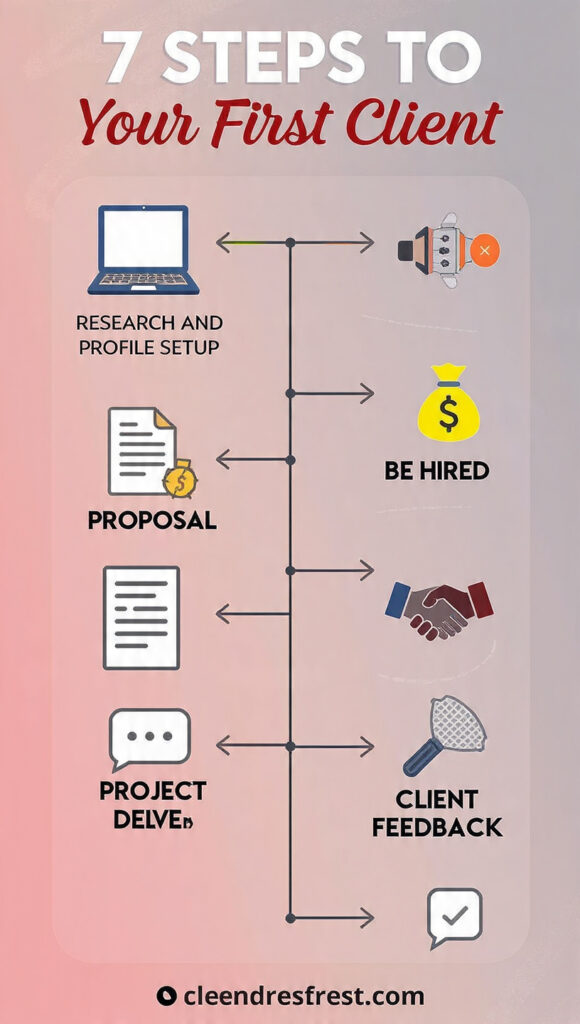
Here’s roughly what to expect if you’re starting from zero:
Week 1–2: Profile setup, niche research, first 5–10 proposals sent
Week 3-4: Refining proposals based on what gets responses (or doesn’t), adjusting your profile
Week 5-8: First client response, first contract, first review
Month 3-6: 3–5 reviews, starting to get invited to jobs, slowly raising rates
This isn’t a guaranteed timeline, but it’s a realistic one. Some people move faster, some slower. The variable that matters most is the quality of your proposals and the specificity of your niche.
Final Thought
The freelancers from Nepal who build real careers on Upwork aren’t the ones with the most experience or the lowest prices. They’re the ones who figured out how to communicate their value clearly, show up consistently, and treat every project — even small ones — like it matters.
Your first client is closer than you think. Write one genuinely good proposal today. Not ten average ones. One good one.
That’s usually how it starts.
*Looking to learn more about freelancing in Nepal? Topics like building a freelance portfolio from scratch, navigating Nepal’s banking options for international payments, and pricing strategies for Nepali freelancers are worth exploring as your Upwork journey progresses.*
Also check: